


- How a POS helps electronics stores manage inventory by model, colour, storage capacity, and other product specifications.
- Why recording warranty information at the point of sale supports faster after-sales service and more connected records.
- How multi-outlet visibility helps retailers keep inventory aligned across different store locations.
- How to evaluate POS features that support spec-level inventory, warranty tracking, and multi-outlet visibility for electronics retail.
A customer walks into an electronics store looking for a specific laptop. Not just any laptop, but the silver model with 16GB RAM, a 512GB SSD, and the latest processor. The sales advisor smiles, knowing this customer has already done their homework. Now comes the real test: finding that exact configuration on the shelf.
The stockroom has several versions of the same laptop, each with different specifications. The customer also asks about warranty coverage before making a decision. Every answer depends on accurate product records, connected inventory, and information that is easy for staff to access during the conversation.
That is why many electronics retailers in Singapore use a POS to bring inventory, warranty records, checkout, and reporting into one connected workflow. When every specification is recorded consistently, daily operations become easier to manage while customers receive faster and more accurate service.
Editors Pick
- What is a POS system? A complete guide for SMEs
- How Does a POS System Work? A Step-by-Step Guide
- How to Choose a POS System
- How to Read POS Report
Electronics retail runs on accuracy, and every detail counts
Every sale in an electronics store depends on accurate information. Product specifications, warranty periods, serial numbers, and inventory records all influence the customer experience. A POS designed for electronics retail keeps these details connected, helping staff answer questions confidently while maintaining consistent records throughout the business.
Electronics retail revolves around product details. Customers compare specifications carefully before making a purchase, and even products within the same model family can have several variations.
A smartphone may be available in different colours and storage capacities. A laptop may offer multiple processor and memory combinations. Gaming consoles often come with different bundle packages. To a customer, these differences matter just as much as the product name itself.
A spreadsheet might tell you that a laptop is available. A customer, however, is looking for the silver version with 16GB RAM. It is a small distinction on paper, but an important one at the sales counter.
A POS designed for electronics retail keeps inventory records, sales history, warranty information, and customer transactions together in one system. Staff can check availability quickly, confirm specifications with confidence, and continue serving customers without switching between separate records.
What makes inventory management different for an electronics store?
Electronics inventory is managed at the specification level, not simply by product name. A modern electronics inventory management POS tracks every variation, helping retailers maintain accurate stock records for high-value products while making product searches faster for store staff.
A customer looking for a 256GB smartphone usually wants that exact configuration. A 128GB model or a different colour may not meet their preference. Accurate inventory starts with recognising these individual product specifications.
A strong electronics store POS Singapore supports inventory tracking across details such as:
| Inventory Detail | Example |
|---|---|
| Product Model | Laptop Model A |
| Colour | Silver, Black |
| Storage Capacity | 256GB, 512GB, 1TB |
| Memory | 8GB RAM, 16GB RAM |
| Bundle Type | Standard Package, Gaming Bundle |
| Serial Number | Individual device identification |
| Warranty Period | 12 months, 24 months |
Tracking products at this level gives staff immediate visibility into what is available. It also supports more accurate stock counts for products with higher values, where every individual unit contributes meaningfully to inventory value.
Each completed sale updates inventory automatically. Returns, exchanges, and stock adjustments follow the same connected workflow, keeping stock records aligned throughout the day.
For retailers operating stores in locations such as Jurong, Tampines, and Orchard, this visibility extends across every outlet. Staff can quickly identify where a particular configuration is available and coordinate inventory transfers when customer demand shifts between locations.
How does a POS handle warranty tracking for every sale?
Warranty information is an important part of the ownership experience for many electronics products. Recording warranty details during checkout keeps customer records connected to every purchase and supports efficient after-sales service whenever customers return.
Customers often revisit the store months after purchasing a laptop, television, or smartphone. They may ask about warranty coverage, servicing options, or proof of purchase. Having these records connected to the original transaction helps staff assist them quickly.
A warranty tracking POS records key information automatically during the sale, including:
- Purchase date
- Warranty period
- Product model
- Serial number
- Customer information
When customers return, staff can retrieve the original transaction and confirm warranty details directly from the POS. The conversation stays focused on helping the customer rather than searching through separate files.
This approach supports:
- Faster warranty verification
- More consistent after-sales service
- Connected customer records
- Better transaction traceability
Electronics retailers can manage sales and warranty information within the same platform, keeping records connected from the point of sale.
The same information can also be accessed across multiple outlets, giving customers a consistent service experience regardless of where they purchased the product.
Keeping checkout fast for high-consideration purchases
Buying electronics is often a considered decision. Customers compare specifications, ask about warranty coverage, explore payment options, and occasionally add accessories before completing their purchase. Once they are ready to pay, the checkout experience should feel just as organised as the sales conversation.
Singapore has one of the world’s most mature digital payment ecosystems. According to the Monetary Authority of Singapore and the Infocomm Media Development Authority, payment methods such as PayNow and SGQR are widely adopted across retail, giving customers the flexibility to pay using their preferred banking or mobile wallet application.
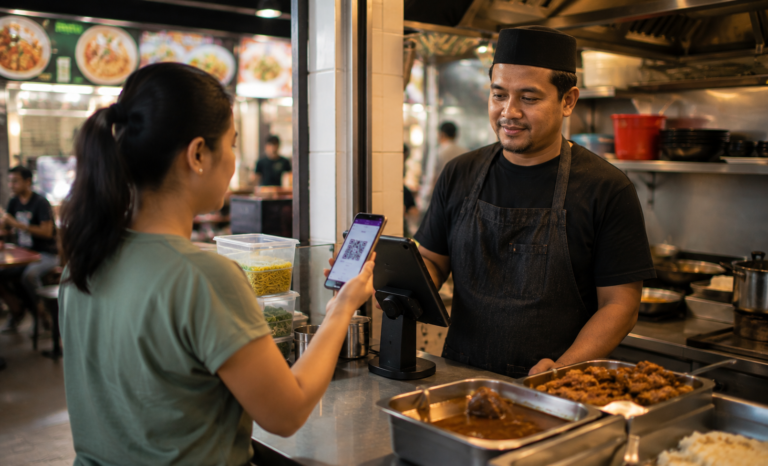
For electronics retailers, payment flexibility also supports smoother operations at the checkout counter. A customer paying for a laptop with PayNow can complete the transaction by scanning the SGQR code, while another customer purchasing headphones may prefer a credit card. The cashier can process both transactions through the same POS while maintaining consistent sales records.
For example, Labamu’s POS Cashier records product specifications and warranty details automatically during checkout while supporting PayNow, SGQR, and card payments.
Because warranty information, payment details, and inventory updates are captured within the same transaction, staff can continue serving customers while the system maintains complete sales records in the background.
How do you track performance across multiple store locations?
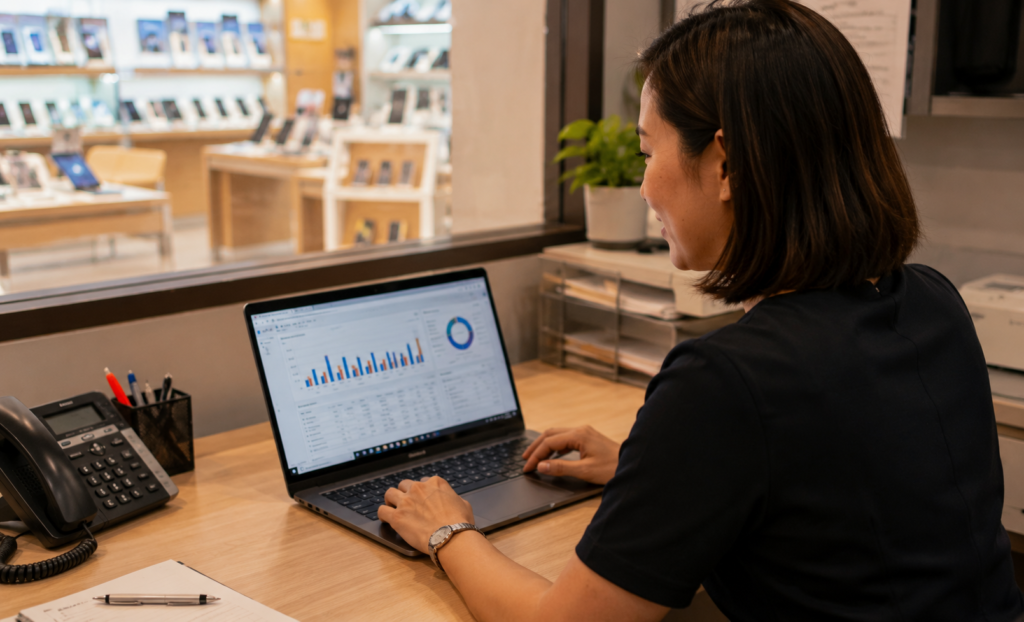
As an electronics business grows, visibility across every outlet becomes just as important as visibility within each store. Managers need reliable information about sales performance, inventory movement, and customer demand to make confident operational decisions.
A multi-outlet electronics POS Singapore provides a central dashboard that combines sales and inventory data from every location while still allowing managers to review each outlet individually.
Typical reports include:
- Revenue by outlet
- Gross profit by outlet
- Transaction count
- Product category performance
- Staff sales performance
- Inventory movement between stores
Imagine three stores located in Jurong, Tampines, and Orchard.
Customers visiting Orchard may show stronger interest in premium laptops, while shoppers in Jurong purchase more desktop accessories. Tampines may experience steady demand for smartphones throughout the week. These are examples of how buying patterns can differ between locations, and reporting makes those trends visible.
When managers understand local demand, inventory planning becomes more accurate. Products can be transferred between outlets based on current sales activity, helping each location maintain the product mix customers are looking for.
A connected POS also records every stock transfer, creating a complete inventory history that managers can review whenever products move between stores.
Reading your sales data to improve buying decisions
Sales reports help electronics retailers understand more than total revenue. They reveal which product specifications generate stronger margins, which accessories are commonly purchased together, and how customer demand changes across categories. These insights support inventory planning based on actual sales activity and help purchasing teams build a balanced product assortment.
For example, reporting may show that:
- A 512GB laptop configuration consistently generates a stronger margin than the 256GB model.
- Wireless mice are frequently purchased together with business laptops.
- Gaming monitors experience higher demand during selected promotional periods.
- Tablets see stronger sales in one outlet than another.
These examples illustrate how transaction data becomes useful beyond daily reporting.
Retailers can use current sales data to guide replenishment planning, grounding purchasing decisions in actual customer demand.
Managers can also review inventory turnover by category to identify products that sell steadily over time and products that move at a different pace. This supports purchasing schedules that stay aligned with customer preferences while maintaining a balanced inventory across the business.
Performance reporting becomes even more valuable when viewed alongside outlet-level data. One location may consistently perform well in premium smartphones, while another generates stronger sales from home office equipment. These insights help retailers allocate inventory where customer demand is strongest.
Electronics retailers exploring technology investments can look into government support programmes such as the Productivity Solutions Grant, administered by IMDA. Eligible solutions can be found through GoBusiness Tech Depot.
Businesses with annual taxable turnover exceeding S$1 million are required to register for GST, according to the Inland Revenue Authority of Singapore (IRAS). A POS that maintains organised transaction records supports day-to-day reporting and GST record keeping as the business grows.
Running your electronics store with a more connected POS
Running an electronics store means managing thousands of details every day. Product specifications, serial numbers, warranty records, payment methods, inventory movement, and sales reporting all contribute to the customer experience.
When these activities are connected through one POS, staff spend less time searching for information and more time helping customers choose the right products. Managers gain clearer visibility into inventory, outlet performance, and purchasing trends, making day-to-day decisions more informed and consistent.
As the business expands across multiple locations, this connected view becomes even more valuable. Inventory can move between stores with a clear record of every transfer, warranty information remains linked to each sale, and performance reports provide a complete picture of how every outlet contributes to overall growth.
Labamu is one example of a modern POS built for electronics retailers in Singapore. Its POS Cashier, spec-level inventory management, warranty tracking, Multi Outlet Support, and Insight reporting help retailers manage daily operations through one connected platform.
See how Labamu supports daily operations for electronics stores in Singapore.