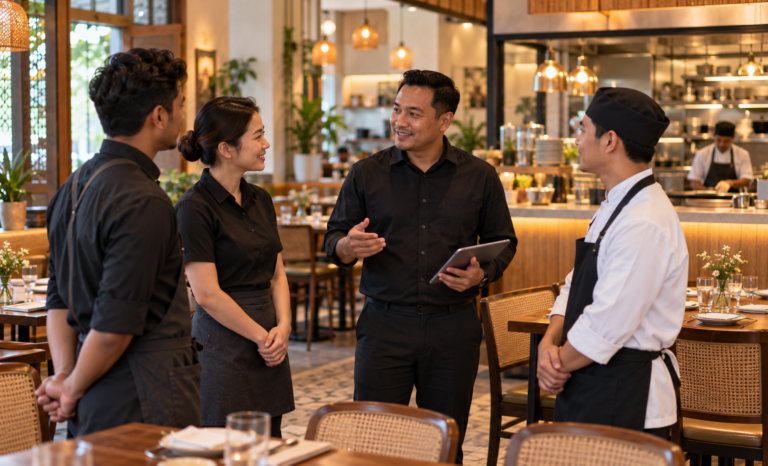


In Singapore, a queue outside a restaurant is often read as a good sign. Diners join one at lunch around Raffles Place and Tanjong Pagar, for weekend brunch in Tiong Bahru, and at popular spots that skip reservations altogether. Even at hawker centres, the habit of reserving a seat with a packet of tissue shows how much Singapore diners care about a fair turn. For the restaurant, that line at the door is real demand waiting to become seated covers.
A good queue system turns that demand into a calm, fair experience for guests and a steady flow for the team. This guide explains what a restaurant queue system does, the main types available, the psychology of waiting, how to run a queue at peak hours, how to balance walk-ins with reservations, and which numbers show the queue is working.
Key takeaways:
- A restaurant queue system records walk-in guests, their party size, and their place in line, then connects them to the right table as it becomes available.
- Options range from a paper list to a digital waitlist that guests can join themselves and that links directly to live table status.
- Waits feel shorter when guests are occupied, informed, and treated fairly, according to David Maister’s work on the psychology of waiting lines (1985).
- At peak hours, matching party size to table size and quoting realistic times keeps tables filled and guests confident.
- Tracking quoted versus actual wait, walk-aways, and seating duration shows where the queue can flow faster.
Table of contents:
What a restaurant queue system does
A restaurant queue system is the process and tool a restaurant uses to manage walk-in guests waiting for a table. It records each party’s name, size, and arrival order, gives them an expected waiting time, and moves them to a suitable table as one becomes free. The best systems connect the queue directly to live table status.
The core jobs of a queue system
- Record each party. Name, party size, contact details if needed, and any seating preference such as indoor or outdoor.
- Keep the order fair. Guests are seated in a clear sequence, adjusted only for table fit.
- Set expectations. Each party receives a realistic waiting time.
- Match parties to tables. A party of two goes to a two-seat table, a group of six to a table that seats six.
- Connect to the floor. The host sees which tables are seated, finishing, or ready, so the next party is called at the right moment.
Queues and reservations work together
Many restaurants take both reservations and walk-ins. The queue handles guests who arrive as walk-ins, while reservations hold tables for guests with a confirmed time. Running both from the same view of the dining room keeps tables from being promised twice.
Types of restaurant queue systems
Restaurants manage queues in four common ways: a paper list at the host stand, numbered tickets, a digital waitlist that guests can join themselves, and a waitlist connected to reservations and live table status. Each step up adds visibility, so the choice depends on queue length, peak volume, and how closely the queue needs to follow the floor.
| Queue type | How it works | Fits |
|---|---|---|
| Paper list | Host writes names and party sizes on a clipboard | Short queues and quieter periods |
| Numbered tickets | Guests take a number and wait for it to be called | Counter service and fast turnover |
| Digital waitlist | Guests join from their own phone or a tablet at the door | Busy restaurants with regular queues |
| Connected waitlist | The waitlist links to reservations and live table status | Restaurants balancing walk-ins and bookings at peak hours |
Choosing the right type
Start with how often the restaurant has a queue and how long it gets. A short Sunday queue may need nothing more than a tidy list. A daily lunch queue in the CBD, where office crowds often have a fixed lunch hour, benefits from guests joining digitally, so the host spends less time writing and more time seating. When the restaurant also takes reservations, a waitlist connected to the table map keeps both flows aligned.
The psychology of waiting in a restaurant queue
How long a wait feels often matters as much as how long it lasts. David Maister’s widely cited 1985 work, The Psychology of Waiting Lines, sets out eight principles, including that occupied time feels shorter, that known waits feel shorter than uncertain ones, and that fair waits feel shorter than unfair ones. Each principle points to a simple action at the host stand.
The psychology of waiting
Eight ideas that make a queue feel shorter
Each principle, paired with a simple action for the host stand.
01
Occupied time feels shorter
Try: share the menu while guests wait
02
People want to get started
Try: greet and add guests to the list right away
03
Anxiety makes waits seem longer
Try: confirm the party is on the list
04
Known waits feel shorter than uncertain ones
Try: quote a realistic waiting time
05
Explained waits feel shorter
Try: mention when a large table is about to clear
06
Fair waits feel shorter
Try: seat in a clear, visible order
07
Valued experiences earn longer patience
Try: highlight signature dishes in the waiting area
08
Group waits feel shorter than solo waits
Try: offer counter seats to solo diners first
Principles adapted from David Maister, The Psychology of Waiting Lines (1985).
Turning the principles into practice
According to Maister, guests judge a wait by how it feels as well as by the clock. For restaurants, three practices make the biggest difference:
- Give guests something to do. Handing over the menu lets guests choose dishes while they wait, which also speeds up ordering once they are seated.
- Keep the wait clear. A realistic quoted time and an update if it changes keep guests confident.
- Keep the order visible and fair. When guests can see that the queue moves in sequence, they stay patient.
Running a queue at peak hours
Peak hours put the queue under the most pressure, so a clear routine helps. Record each party as soon as they arrive, quote a time based on live table status, keep guests updated, match party size to table size, and update the table status the moment a party is seated. Each step keeps the next quote accurate and the dining room full.
Peak-hour playbook
From arrival to seated in five steps
- 1
Greet and record
Add the guest name, party size, and seating preference to the list.
- 2
Quote a realistic time
Base it on live table status and how long tables usually stay seated.
- 3
Keep guests informed
Share updates if the wait changes, and offer the menu while they wait.
- 4
Match the right table
Pair party size with table size, and hold each table for a set time.
- 5
Seat and update
Mark the table as seated so the next quote stays accurate.
Quoting realistic waiting times
A good quote starts with the floor. Look at which tables are finishing, how many parties are ahead, and how long tables usually stay seated at that time of day. Quoting slightly conservatively and seating guests earlier than promised leaves a better impression than the reverse.
Matching parties to tables
Party size drives table choice. Keeping a mix of two-seat tables that can join for larger groups gives the host more options, and counter seats suit solo diners. When a larger table frees up, the host can decide whether to seat a waiting group or split the table for two smaller parties, depending on the queue. Our guide to restaurant layout and floor plans covers how to plan a flexible table mix.
Holding tables for called guests
Set a short, clear hold time for guests who have been called but have stepped away. Once the hold time passes, the table moves to the next party in line, and the earlier guest returns to the queue. Telling guests the hold time when they join keeps the rule fair and transparent.
Balancing walk-ins and reservations
Restaurants that take both bookings and walk-ins plan the evening around two flows. Reservations hold specific tables for specific times, while the queue fills every other table as it frees up. Seeing both on one view of the dining room lets the host seat walk-ins confidently, knowing which tables are already promised.
Planning tables for both flows
- Decide how many tables, or which sections, stay available for walk-ins at each service.
- Leave a buffer between a walk-in seating and an upcoming reservation at the same table.
- Release a reserved table to the queue after a set grace period if the booked guests have yet to arrive.
- Review the split regularly using actual walk-in and booking patterns.
For a full look at bookings, see our guide to the restaurant reservation system.
Measuring queue performance
A few simple numbers show whether the queue is working. Compare quoted and actual waiting times, count guests who leave the queue before being seated, and track how long tables stay seated during busy periods. Together, these numbers show where to adjust quotes, the table mix, or staffing to keep the queue moving.
Numbers worth tracking
| Metric | What it shows | How to use it |
|---|---|---|
| Quoted vs actual wait | How accurate the host’s quotes are | Adjust quotes by time of day |
| Walk-aways | Guests who leave the queue before being seated | Spot periods that need faster seating |
| Average seating duration | How long parties stay at the table | Plan quotes and table turnover |
| Queue length at peak | How much demand arrives at once | Plan staffing and walk-in tables |
Seating duration links directly to table turnover. Our article on table turnover rate explains how to measure it and what it tells you about the dining room.
Labamu RMS for queues and walk-ins
Labamu is a connected business platform built for businesses in Singapore, and Labamu Restaurant Management System (RMS) brings the queue and the dining room into one view. With Labamu Reservations, guests can book or join a waitlist automatically, and staff manage walk-in guests and reservations in one connected system, with live table availability.
Waitlist, walk-ins, and reservations together
Labamu Reservations lets customers book or join a waitlist automatically, which reduces manual phone calls and paperwork at the host stand. Walk-in guests and reservations sit in one connected system, so the host can seat queued guests while keeping booked tables protected.
Live table availability
Staff can view open and occupied tables instantly, with live updates, and see which seats are free, occupied, or reserved for future guests. With Labamu Table Management, the floor plan also shows table status and seating duration at a glance, which helps the host quote waiting times with confidence.
A well-run queue turns a busy door into a full dining room. Explore Labamu Reservations to see how walk-ins, waitlists, and bookings work together for your restaurant.
Frequently asked questions
What is a restaurant queue system?
A restaurant queue system is the process and tool a restaurant uses to manage walk-in guests waiting for a table. It records each party’s name, size, and arrival order, gives them a waiting time, and seats them at a suitable table as one becomes free.
How do restaurants manage walk-in queues?
Most restaurants record each party on arrival, quote a realistic waiting time, keep guests updated, match party size to table size, and update table status when guests are seated. A digital waitlist connected to live table status makes each step faster at peak hours.
What is the difference between a waitlist and a reservation?
A reservation holds a specific table for a guest at a confirmed time. A waitlist, or queue, lines up walk-in guests in order and seats them as tables become free. Many restaurants run both, with the queue filling tables between bookings.
Can guests join a restaurant queue online?
Yes, with a digital waitlist. Guests can join from their own phone or a device at the door, depending on the system. With Labamu Reservations, customers can book or join a waitlist automatically, and staff see walk-ins and reservations together.
How can restaurants make waiting feel shorter?
Keep guests occupied, informed, and treated fairly. Sharing the menu while guests wait, quoting a realistic time, updating them if it changes, and seating in a clear order all make waits feel shorter, in line with Maister’s psychology of waiting lines.
What should a restaurant track in its queue?
Useful numbers include quoted versus actual waiting time, the number of guests who leave before being seated, average seating duration, and queue length at peak. Reviewing them weekly helps restaurants adjust quotes, table mix, and staffing.