


When customer is looking for a navy polo shirt in size M. Another customer is exchanging a jacket purchased earlier in the week. At the same time, an online order arrives for a product displayed on the sales floor.
This mix of transactions is a normal part of fashion retail in Singapore. Clothing stores manage hundreds or even thousands of product variants, seasonal promotions, and customer requests throughout the day.
A modern POS helps bring these activities together in one connected system. From inventory updates and checkout transactions to returns and online orders, the right setup helps store teams keep operations organised while maintaining visibility across the business.
Editors Pick
- What is a POS system? A complete guide for SMEs
- How Does a POS System Work? A Step-by-Step Guide
- How to Choose a POS System
- How to Read POS Report
A busy clothing store has more moving parts than most retail formats
A clothing store manages inventory at the variant level, where one product can exist in multiple sizes and colours. Daily operations often involve stock checks, customer purchases, returns, exchanges, and online orders happening simultaneously. A POS built for fashion retail helps connect these activities through a single source of information, giving staff accurate visibility throughout the day.
Unlike many retail categories, apparel stores work with products that come in multiple combinations of size, colour, and style. A single dress on display may represent dozens of inventory records behind the scenes.
Now add several activities happening at once:
- Customers making purchases
- Staff checking inventory availability
- Online orders entering the system
- Exchanges at the cashier counter
- New inventory arriving from suppliers
Each activity affects stock levels in real time.
A fashion-focused POS gives store teams a single view of inventory and transactions. Staff can access current information from the sales floor, the fitting room, or the cash counter, helping everyone work from the same set of records.
There is a practical benefit here. When every department sees the same inventory information, communication becomes smoother and customer questions can be answered more confidently.
What makes inventory management different for a clothing store?
Inventory management in fashion retail revolves around variants. While shoppers see one shirt design, the business tracks each size and colour combination separately.
Consider a simple example:
| Product | Variants |
|---|---|
| Men’s Oxford Shirt | XS, S, M, L, XL |
| Colour Options | White, Blue, Black, Grey |
| Total SKUs | 20 |
Although the product appears as a single item on the rack, the store manages 20 individual SKUs.
This is where retail POS variant management becomes important. Every sale updates the exact size and colour purchased, keeping stock records aligned with what is available in the stockroom and on the sales floor.
Customers often ask questions such as:
“Do you have this in medium?”
A POS allows staff to verify availability immediately and provide a clear answer while continuing to assist customers on the floor.
Real-time stock visibility also supports inventory planning. Managers can identify popular sizes and colours early, helping them schedule replenishment at the right time and maintain strong product availability throughout the season.
How does a POS handle fast checkout during seasonal sales?
Seasonal shopping periods bring valuable opportunities for clothing retailers.
Events such as the Great Singapore Sale, Chinese New Year shopping campaigns, Hari Raya promotions, and year-end sales often increase customer traffic significantly. During these periods, checkout speed becomes an important part of the customer experience.
A POS supports efficient checkout through:
- Fast product search and scanning
- Automatic promotion calculations
- Integrated payment processing
- Real-time inventory updates
- Digital transaction records
Payment flexibility plays an important role in Singapore’s retail environment. Many customers prefer cashless payment methods as part of their daily shopping habits.
Common payment methods include:
- PayNow
- SGQR
- Credit cards
- Debit cards
- Cash
Supporting these payment methods through one checkout workflow helps keep queues moving during busy trading periods.
For example, Labamu POS Cashier supports flexible payment methods including PayNow, SGQR, cards, and cash while updating stock automatically after each transaction. This helps sales records and inventory remain aligned during peak traffic periods.
There is also a customer service benefit. A shorter wait at the cashier means shoppers spend more time browsing collections and less time standing in line. During a busy weekend, that can make a noticeable difference to the overall store experience.
How do returns and exchanges work through a POS?
Returns and exchanges are part of everyday fashion retail operations.
A customer may exchange a size L shirt for a size M. Another customer may return a product and choose a different colour. Each transaction affects inventory and sales records.
A POS helps staff retrieve the original purchase details quickly, including:
- Transaction date
- Product purchased
- Variant information
- Payment method
- Purchase value
When a return or exchange is processed, inventory updates automatically.
| Transaction Type | Inventory Action |
|---|---|
| Return | Item added back to stock |
| Exchange Size L to M | L returned to stock, M deducted |
| Exchange Colour | Original colour restocked, new colour deducted |
Because updates happen immediately, inventory records remain accurate throughout the day.
The transaction history also gives managers a clear audit trail. This makes it easier to review activity, monitor product movement, and maintain accurate records across the business.
Keeping online and offline stock in sync
An omni-channel POS clothing retailers use connects inventory across physical stores and online sales channels. When a customer buys a product online, inventory updates automatically across the business. When an item is returned in-store, stock availability updates accordingly. This shared inventory view helps maintain accurate availability information wherever customers choose to shop.
Many fashion retailers serve customers through both physical and digital channels.
A customer may browse products online before visiting the store to try them on. Another customer may complete a purchase online and collect it at the store later that day.
A connected inventory system helps maintain accurate stock visibility across these interactions.
When inventory is synchronised:
- Online purchases update available stock instantly
- In-store transactions update online inventory records
- Returns refresh stock availability across channels
- Product listings reflect current inventory levels
Consider a situation where one medium-sized jacket remains in stock. If a customer purchases it online, the inventory record updates immediately. Staff at the physical store can see the latest availability and provide accurate information to walk-in shoppers.
For fashion retailers managing multiple sales channels, this level of visibility helps support smoother fulfilment and stronger inventory accuracy throughout the business.
Reading your sales data to plan the next restock
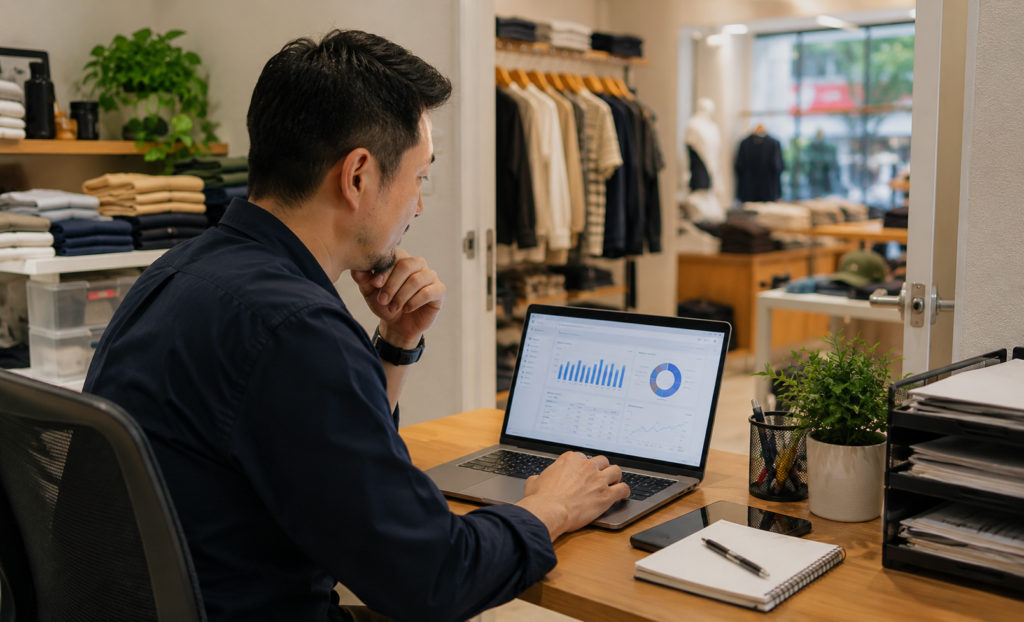
Inventory management is also about understanding what customers buy and how product demand changes over time.
Modern POS systems transform transaction data into reports that support better purchasing and merchandising decisions.
Store managers can review:
- Best-selling sizes
- Popular colours
- Top-performing categories
- Revenue by collection
- Product profitability trends
For example, a store might discover that black shirts sell twice as quickly as white shirts, medium and large sizes generate most sales, or casualwear performs particularly well during a certain season.
These insights help managers make restocking decisions based on actual customer purchasing behaviour.
Sales data can also support stronger inventory turnover by helping buyers focus on products, variants, and categories that consistently perform well.
Accurate reporting becomes increasingly important as a business grows. According to IRAS, businesses generally need to register for GST when taxable turnover exceeds S$1 million annually. Clear sales records help retailers understand performance trends while supporting reporting and compliance requirements.
Clothing store owners exploring technology investments can look into government support programmes such as the Productivity Solutions Grant, administered by IMDA. Eligible solutions can be found through GoBusiness Tech Depot.
Running your clothing store with a connected POS
A successful clothing store balances inventory accuracy, customer service, sales performance, and operational visibility every day.
Managing dozens of product variants, processing exchanges, accepting multiple payment methods, and coordinating online and offline inventory becomes much easier when these activities operate through one connected platform.
A modern POS for clothing store Singapore retailers use today helps maintain visibility across inventory, transactions, and sales trends. Staff can access current stock information, managers can review performance data, and customers can enjoy a more consistent shopping experience across channels.
Solutions such as Labamu are one example of how apparel POS Singapore retailers can manage variant inventory, support omni-channel inventory synchronisation, and access sales insights through a connected reporting environment.
As a business grows, having a clear view of products, sales, and inventory helps create a retail operation that is organised, responsive, and ready for future opportunities.
See how Labamu supports daily operations for clothing stores in Singapore.