

- The two things that define a cafe owner’s day in Singapore, and the POS functions that support both
- What makes a cafe POS different from a generic register, and why that difference matters at peak hours
- How QR self-ordering and loyalty programmes turn a busy morning into a customer who comes back
- What to look for when choosing a POS built for cafe workflows in Singapore
The regulars know what they want before they reach the counter. The takeaway queue is already four deep at 8am, and two more walk in while the barista is still keying in a double shot with oat milk, extra hot. A cafe that handles this moment well does not slow down. One that handles it consistently builds the kind of customer who does not consider going elsewhere.
That consistency comes from the system running behind the counter. A POS built for cafe workflows keeps the queue moving, separates takeaway from dine-in without confusion, and gives the owner a clear picture of the day by the time the last table clears.
The morning rush sets the tone for the whole day
The first two hours of a cafe’s day shape everything that follows: the pace, the mood, the till.
Speed at the counter determines whether the takeaway queue becomes a line people leave or one they wait through. And the customers who come back, the ones who have their usual and pay before you finish saying the total, are the ones a cafe is built around. A POS that supports both of these things, fast throughput at peak and a reason for regulars to return, earns its place in the operation before lunch.
What a cafe POS handles across a typical day
A cafe POS runs the full arc of the day, from the first takeaway order to the final sales summary at close.
At its core, it handles order entry, payment processing, order-type separation (takeaway, dine-in, delivery), and a running record of every transaction. What separates a cafe POS from a generic register is how it is built around drink-first workflows. Modifiers are part of the job: oat milk, extra shot, half sugar, iced. A standard retail register handles items with fixed prices and fixed descriptions. A cafe POS holds drink modifiers, preset order combinations for fast entry, and the speed-first layout a counter needs when there are four people in the queue.
The full-day view matters too. Breakfast, the mid-morning lull, the lunch run, the afternoon walk-in. A cafe POS records all of it, by order type and payment method, and surfaces that data at close.
Keeping the morning takeaway queue moving
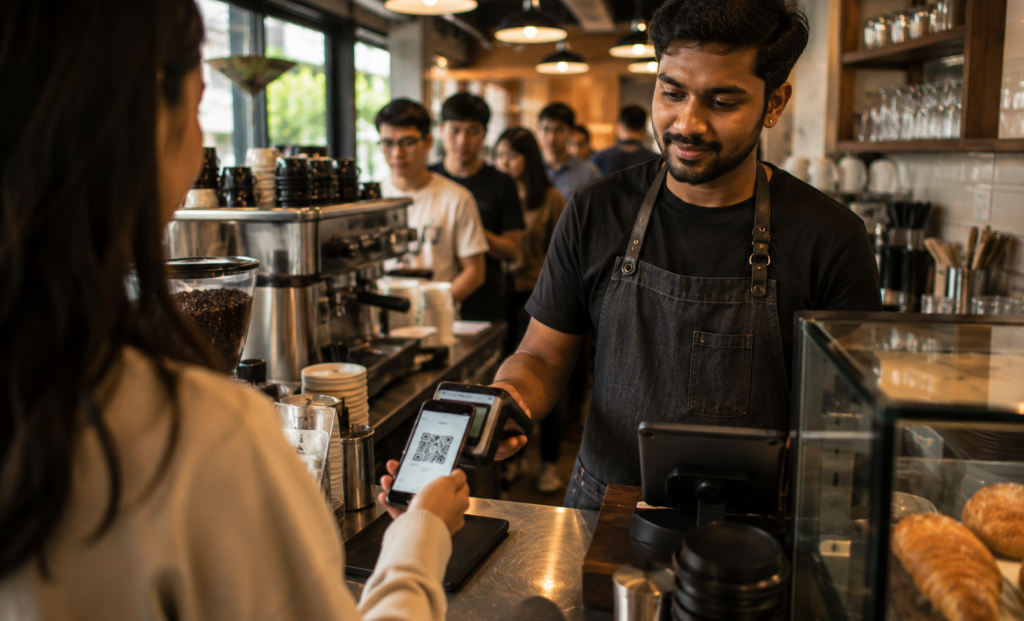
Seconds per order add up fast when the queue is deep.
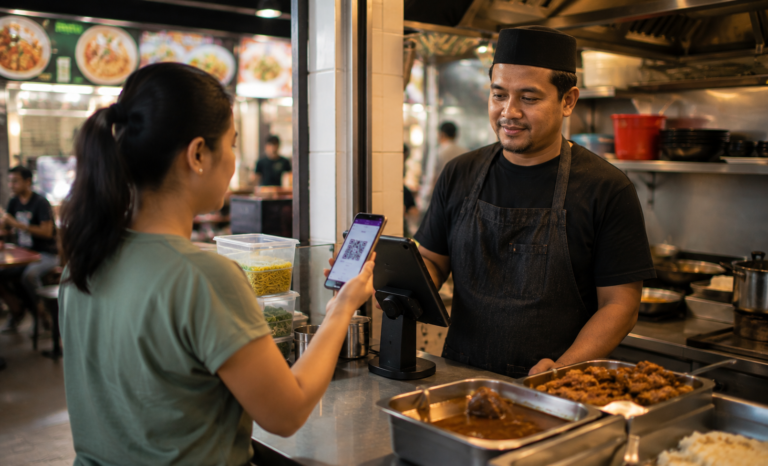
A cafe POS built for peak-hour throughput is designed to reduce the number of taps between order and payment. Popular drinks are pre-set so a flat white with oat milk is one tap, not four fields. Modifiers are added in one step at the order screen. Payment via PayNow or SGQR clears in seconds, with no cash handling and no change to count. The barista calls the order, the customer pays, and the next person is already stepping forward.
This rhythm is the difference between a queue that moves and one that stalls. When a cafe is running ten to fifteen takeaway orders in the first thirty minutes of the day, shaving seconds off each transaction is not a minor detail. It compounds across the morning.
Pre-set combinations also reduce errors. When the most common orders are locked in as quick-select buttons, the barista is confirming rather than building from scratch each time, and the chance of a wrong modifier reaching the cup drops.
Turning busy mornings into returning customers
Speed gets a customer through the door. Loyalty brings them back tomorrow.
A QR menu at the table or counter lets customers browse and self-order without queuing at the register. During a busy morning, this moves a portion of the dine-in crowd off the main counter queue, so the barista handles fewer simultaneous demands at once. Orders arrive at the POS directly, no verbal relay, no misheard modifiers.
Loyalty programmes work in the same direction. A customer who earns points on every flat white has a reason to choose this cafe over the one across the road. The reward does not need to be large; the habit is the point. Labamu’s QR Menu and Loyalty features connect both of these directly to the POS, so self-ordering eases the counter during peak hours and loyalty points accumulate automatically without a separate stamp card or manual log. A busy morning becomes a set of repeat visits, recorded and rewarded through the same system.
The combination matters because it shifts the relationship. A fast transaction is forgettable. A fast transaction that earns a reward is one the customer thinks about the next morning when they are deciding where to stop.
Separating takeaway, dine-in, and delivery cleanly
A cafe running all three order types in the same morning needs the POS to keep them distinct.
Takeaway, dine-in, and delivery each move through the operation differently. Takeaway closes the moment the customer pays and picks up. Dine-in stays open across courses and closes at the table. Delivery routes to a third-party platform and needs its own tracking. When all three run through one system with clear tagging, the barista knows which cup to call out and which order to hold for the rider.
The reporting benefit is just as practical. End of day, a cafe owner can see revenue broken down by order type. If takeaway is growing and dine-in is flat, that is a signal worth knowing. If delivery margins are lower because of platform fees, the data is there to act on. Clean order-type separation is what makes that analysis possible.
When order types are mixed or manually tracked, the numbers blur. The POS keeps them distinct without asking the team to do anything extra.
What daily sales data tells a cafe owner
The close of day is when the POS pays off in a different way.
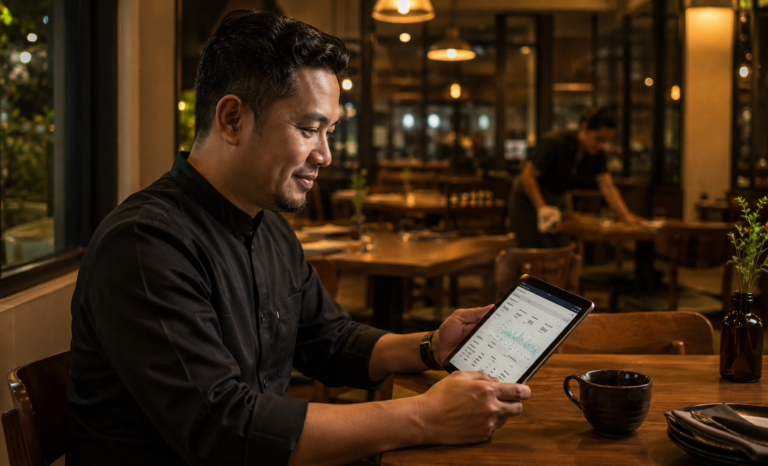
A daily sales view from a cafe POS shows which drinks sold, at what volume, and at what time. The morning rush is visible as a peak in the data. The mid-afternoon lull shows up too. A barista who clocks out at 2pm and a delivery surge that starts at noon are both patterns a cafe owner can plan around, once the data makes them visible.
Ingredient and stock signals come from the same record. If a particular syrup runs low every Friday, the purchase order can go in on Thursday. If a seasonal drink is outselling expectations, the menu can shift to reflect it before the weekend.
IRAS reporting also sits inside this layer. Every transaction is recorded with its payment method and amount. At the end of the reporting period, the data is already structured rather than assembled from receipts.
| Daily insight | What the data shows | Action it enables |
|---|---|---|
| Best-selling drinks | Volume by item across the day | Menu planning, ingredient orders |
| Peak-hour patterns | Transaction spikes by time slot | Staffing decisions for the next week |
| Order type breakdown | Takeaway vs dine-in vs delivery | Channel strategy and margin review |
| Payment method split | Cash, PayNow, card, SGQR | Reconciliation and cashless planning |
| Slow-moving items | Low-volume items across the week | Menu editing, promotion decisions |
Choosing a POS that fits the way your cafe runs
A cafe has a specific shape to its day, and the right POS reflects that.
Fast checkout at peak hours, QR self-ordering that eases the counter, clean separation of takeaway and dine-in, a loyalty programme that runs without manual effort, and a daily sales view that is ready by close. These are not optional extras. They are what a busy Singapore cafe needs from a POS on any given morning.
Labamu brings these capabilities together in one connected system built for cafe teams in Singapore. Fast checkout, QR Menu for self-ordering, Loyalty for regulars, and daily reporting are all part of how the platform works, so the morning rush, the midday lull, and the end-of-day close all run from the same record.