

A four-top lingering over the last of the teh tarik long after the bill is settled is a lovely sign of a good meal. It is also twenty minutes the next party spends waiting by the door. Table turnover rate is the number that helps a restaurant balance both: guests who feel welcome, and tables that keep the evening moving.
Singapore’s food and beverage services sales eased 1.6% year on year in August 2026, and restaurants recorded a 2.1% dip (SingStat, 2026). In that climate, how often each table turns is one of the most practical numbers a restaurant can track. This guide covers how to calculate table turnover, what industry benchmarks look like, where table time goes during a meal, and practical ways to raise turnover while guests still feel looked after.
Key takeaways:
- Table turnover rate equals the number of parties served divided by the number of tables, measured over one service or one day.
- Industry benchmarks place family restaurants at about three turns per dinner and fine dining at one to two turns per service.
- Seat turnover and RevPASH (revenue per available seat-hour) add detail that table turnover alone can miss.
- Every table cycle moves through six stages, from seating to reset, and small gains in each add up.
- Tracking turnover by time slot shows exactly where peak hours have room to grow.
Table of contents:
What table turnover rate is and why it matters
Table turnover rate measures how many parties each table serves during a set period, such as one dinner service. It shows how efficiently the dining room turns seats into covers. A higher rate usually means more guests served from the same space, as long as each guest still enjoys an unhurried, well-paced meal.
The formula, step by step
The standard formula is simple: table turnover rate equals the number of parties served divided by the number of tables (Toast).
- Choose a period, such as lunch, dinner, or the full day.
- Count the parties served in that period.
- Count the tables in the dining room.
- Divide parties by tables.
In a worked example from the same source, a restaurant with 15 tables serving 45 parties between 5pm and 10pm reaches a turnover rate of 3. Each table turned three times, or roughly once every 1.67 hours across the five-hour service.
Table turnover, seat turnover, and RevPASH: three ways to read the floor
Table turnover is the starting point, and two related metrics make the picture sharper.
| Table turnover | Seat turnover | RevPASH | |
|---|---|---|---|
| Formula | Parties served ÷ tables | Covers served ÷ seats | Revenue ÷ (seats × hours open) |
| What it shows | How often each table is reused | How fully seats are filled | How much each seat earns per hour |
| Example | 45 parties ÷ 15 tables = 3 | 120 covers ÷ 60 seats = 2 | S$4,500 ÷ (60 seats × 5 hours) = S$15 |
| Best for | Daily service rhythm | Spotting tables seated below capacity | Comparing time slots and pricing |
RevPASH, short for revenue per available seat-hour, is a restaurant revenue management measure discussed in hospitality research by Sheryl E. Kimes at Cornell University (Kimes, 2004). It connects turnover to revenue, which helps when a faster turn and a higher average bill pull in different directions. The example figures in the table are illustrative.
Benefits of tracking turnover from the first week
- A clear read on capacity. The rate shows how many more guests the room can serve before adding a single table.
- Better staffing decisions. Turnover by time slot shows when to add a runner and when a lighter roster is enough.
- Sharper peak-hour planning. Knowing your real turn time helps you quote accurate waits and space bookings well.
Table turnover benchmarks by restaurant type
Benchmarks vary widely by format. Industry data places family restaurants at about three turns per dinner, fine dining at one to two turns per service, and fast food at one table turn every 30 to 60 minutes. The right target depends on your concept, price point, and the experience guests come for.
What industry benchmarks show
Industry benchmarks from Performance Foodservice, cited by Toast, give three reference points:
- Family restaurants: about three turns per dinner service, or roughly one turn every 1.5 hours between 5pm and 10pm.
- Fine dining: typically one to two turns per service.
- Fast food: one turn every 30 minutes to an hour, or 12 to 24 turns per table across a 12-hour day.
These figures are a guide rather than a rule. A ramen bar near Raffles Place and a family zi char restaurant in an HDB estate will naturally run very different rhythms.
Setting a target that fits your concept
Start with your own baseline. Track parties and tables for two weeks across lunch and dinner, then calculate the average turnover for each service. Your target should sit a little above that baseline, in the slots where demand already exceeds seats.
Keep the guest experience in the equation. A tasting menu built around a three-hour evening earns its value from depth, so one turn may be exactly right. A busy casual restaurant with a queue at 7pm gains more from shaving ten minutes off each table than from raising prices.
Where table time goes during a meal
Every table cycle moves through six stages: seating, ordering, kitchen preparation, dining, payment, and reset. Each stage holds a few minutes that can be recovered with better coordination or simple tools. Mapping these stages for your own restaurant shows where the biggest gains sit, often in ordering and payment rather than the meal itself.
Seating and ordering
The cycle starts when a party is seated and ends their first order. Delays here usually come from a table that is still being cleared, menus that take time to arrive, or a server stretched across too many tables.
Having the table set before guests reach it, and greeting them with water and menus in one visit, keeps this stage short. Taking orders by seat number also helps runners deliver each dish to the right guest the first time.
Kitchen and dining
Kitchen time depends on menu complexity and how orders arrive. When orders reach the kitchen complete, with modifiers and notes, cooks start faster and send fewer questions back to the floor.
Dining time is where guests should feel the most relaxed. Rather than rushing this stage, focus on pacing: courses that arrive steadily and dessert offered at the right moment let guests enjoy the meal and finish naturally.
Payment and table reset
Payment can be one of the longer waits in the cycle. Guests wait for the bill, then for the card terminal, then for change. In Singapore, PayNow and SGQR let guests settle in seconds by scanning a code at the table.
Reset closes the cycle. A busser who clears and resets the table while the host seats the next party in sight keeps the gap between parties short.
Table turnover rate
Read the floor, keep the evening moving
Three formulas worth knowing
Table turnover
Parties served ÷ tables
Seat turnover
Covers served ÷ seats
RevPASH
Revenue ÷ (seats × hours open)
Where table time goes, and quick wins
MEAL STAGE
- Seating and ordering
- Kitchen preparation
- Dining
- Payment
- Table reset
QUICK WIN
- Table set before guests arrive
- Complete orders with modifiers and notes
- Courses paced steadily
- PayNow or SGQR at the table
- Busser and host working in sync
Industry benchmarks
~3
Turns per dinner service at family restaurants
1 to 2
Turns per service at fine dining restaurants
72%
Of guests set 30 minutes as their longest wait for a table
Source: Toast, with benchmarks from Performance Foodservice
Labamu Table Management at a glance (early access)
Floor view
- Floor plan and table status
- Seating duration at a glance
Live table status
- Tracked in real time
- From opened to ready for clearing
Orders to the kitchen
- Modifiers and special notes
- Sent in your course sequence
Table operations
- Transfer or merge tables
- Move items between tables
Ways to raise turnover while guests feel welcome
Higher turnover comes from removing waiting, rather than from hurrying guests. Coordinated floor roles, ordering and paying at the table, a focused menu, and a waitlist guests trust each recover minutes per table. Together they let the dining room serve more parties while every guest still enjoys a relaxed, attentive meal.
Hosts, servers, and runners in sync
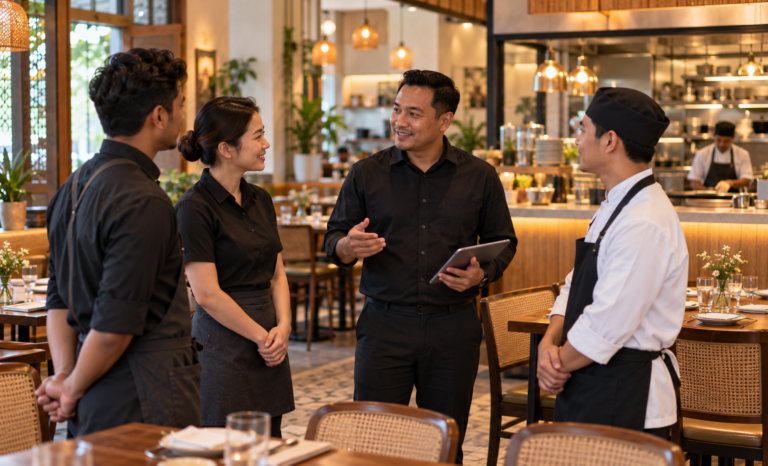
Turnover improves most when the host, servers, and runners work as one team. The host tracks which tables are close to finishing, the server signals when a bill is requested, and the runner clears as soon as guests leave.
Combining tasks into fewer visits helps too. Bringing water and menus together at the greeting, and having the bill ready when guests decline dessert, saves trips for every table.
Ordering and paying at the table
Ordering and paying at the table removes two of the longest waits in the cycle. QR ordering lets guests order as soon as they are ready, and payment by PayNow or SGQR closes the bill in seconds.
Singapore’s refreshed Food Services Industry Digital Plan points the same way. Released by IMDA and Enterprise Singapore in July 2025, it lists solution categories such as automated self-checkout and systems that automate ordering, preparation, and checkout (IMDA, 2025). For turnover, each step handled at the table hands a few minutes back to the cycle.
Menu design and prep
A focused menu speeds up both ordering and the kitchen. Industry guidance suggests keeping each menu category to around seven to ten items (Toast), so guests decide faster and the kitchen prepares a tighter range of dishes.
Prepping condiments, drinks, and some desserts ahead of service shaves further minutes. During the busiest hours, servers can also recommend dishes that are quick to prepare.
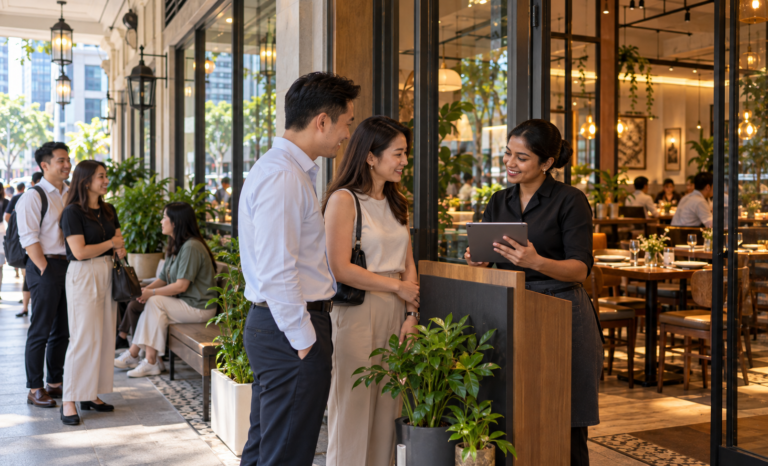
A waitlist guests trust
A clear waitlist keeps guests nearby and ready to sit the moment a table opens. In one industry survey, 72% of guests set 30 minutes as the longest they would wait for a table, and 59% of guests aged 18 to 34 preferred a mobile waitlist or text option (Toast).
Quote realistic waits based on your actual turn time, and send a message when the table is ready. Guests who trust the estimate are happy to wait, and the table fills the moment it is reset.
Managing turnover at peak hours
Peak hours are where turnover matters most, because demand exceeds seats for a short window. The weekday lunch rush, weekend dinners, and festive dates each need a slightly different plan. Tracking turnover by time slot shows which window has the most room to grow and where small changes recover the most covers.
The weekday lunch rush
Office lunch crowds in districts such as Raffles Place and Tanjong Pagar typically plan around a set lunch hour. Speed matters more than lingering here. A shorter lunch menu, set meals, ordering at the table, and payment by QR keep each table moving while guests still return to work on time.
Weekend dinners and festive dates
Weekend dinners and festive dates such as Chinese New Year reunion meals, Hari Raya gatherings, and Deepavali celebrations bring larger groups and longer meals. Fewer turns are natural during these sittings.
Plan with fixed seating times, set menus for large groups, and confirmed bookings, so each sitting starts on schedule and the kitchen can prepare ahead.
Tracking turnover by time slot
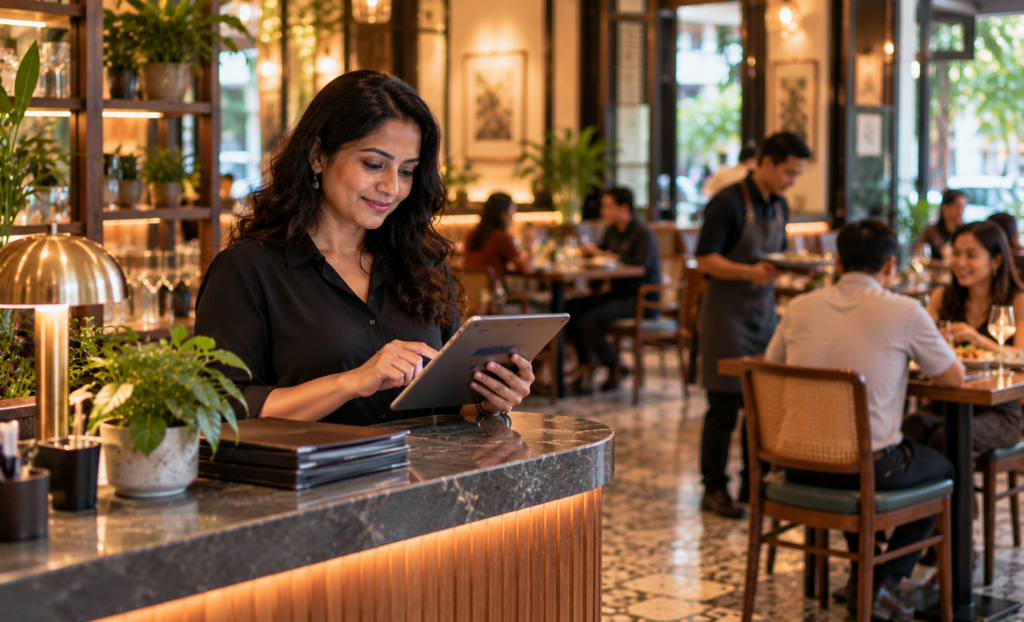
Break your turnover rate into 30-minute or hourly slots. A dinner service with an average of three turns might run at four turns between 6pm and 8pm and two turns after 9pm.
This view shows where to focus. Add staff where turns are highest, and use the quieter slots for promotions or longer, relaxed meals that suit the hour.
Labamu Restaurant Table Management for a faster floor
Labamu is a connected business platform built for businesses in Singapore, and Labamu Restaurant Table Management gives the floor team one clear view of every table: the floor plan, each table’s status, and how long guests have been seated. Orders reach the kitchen from the same app, and the solution is open for early access.
Floor view, table status, and seating duration
Labamu Restaurant Table Management shows the restaurant floor plan, table status, and seating duration at a glance, with each table tracked in real time from opened to ready for clearing. Staff build orders with quantity, modifiers, and special notes, review them before sending, and the items reach the kitchen following the course sequence you set up.
As service changes, staff can transfer or merge tables and move items between tables. Item-level and bill-level discounts follow each staff member’s permissions. Because tables and orders are managed in one app connected directly to the kitchen, information flows straight from the floor to the cooks. For the steps before and around the meal, Labamu Reservations and Labamu QR Menu cover bookings and table-side ordering.
Getting started with Labamu
Start by mapping your floor plan and table sizes, then record your current turnover by service for two weeks. Set targets for the slots with the longest queues, and use seating duration on the floor view to spot tables that are ready for the next party.
Every table tells a story about time. Read it well, and the whole evening flows. Join the Labamu Table Management waitlist to be among the first to try it.
Frequently asked questions
What is a good table turnover rate for a restaurant?
It depends on the format. Industry benchmarks place family restaurants at about three turns per dinner, fine dining at one to two turns per service, and fast food at a turn every 30 to 60 minutes (Toast). Compare your rate with your own baseline and concept first.
How do you calculate table turnover rate?
Divide the number of parties served by the number of tables for a set period. For example, 45 parties across 15 tables during dinner gives a turnover rate of 3. Measure each service separately so lunch and dinner patterns stay clear.
What is the difference between table turnover and seat turnover?
Table turnover counts parties per table, while seat turnover counts guests per seat. If a four-seat table often hosts two guests, table turnover can look healthy while seat turnover shows unused capacity. Tracking both helps match party sizes to table sizes.
What is RevPASH?
RevPASH stands for revenue per available seat-hour. It divides revenue by the number of seats multiplied by the hours open. It connects turnover with spending, so a restaurant can compare time slots and see where longer, higher-value meals or faster turns earn more.
Does a higher turnover rate always mean better performance?
Only when guests still enjoy the meal. A rate that rises because waits are shorter and payment is faster is a strong result. A rate that rises because guests feel rushed can lower spending and repeat visits, so read turnover alongside guest feedback and average bill.
How long do guests usually stay at a table?
It varies by format. In the industry example of three turns across a five-hour dinner, each table turned roughly every 1.67 hours, and family restaurants average about one turn every 1.5 hours at dinner (Toast). Fine dining guests often stay much longer.
Can QR ordering improve table turnover?
Yes, it can shorten two stages of the cycle. Guests order as soon as they are ready, and paying by PayNow or SGQR at the table closes the bill quickly. Keep a server close by for guests who prefer to order in person.
How often should a restaurant review its turnover rate?
Weekly is a good rhythm. Review turnover by service and time slot, compare it with the previous weeks, and adjust staffing, table holds, and booking intervals. Review more often during festive seasons, when demand and party sizes change quickly.