


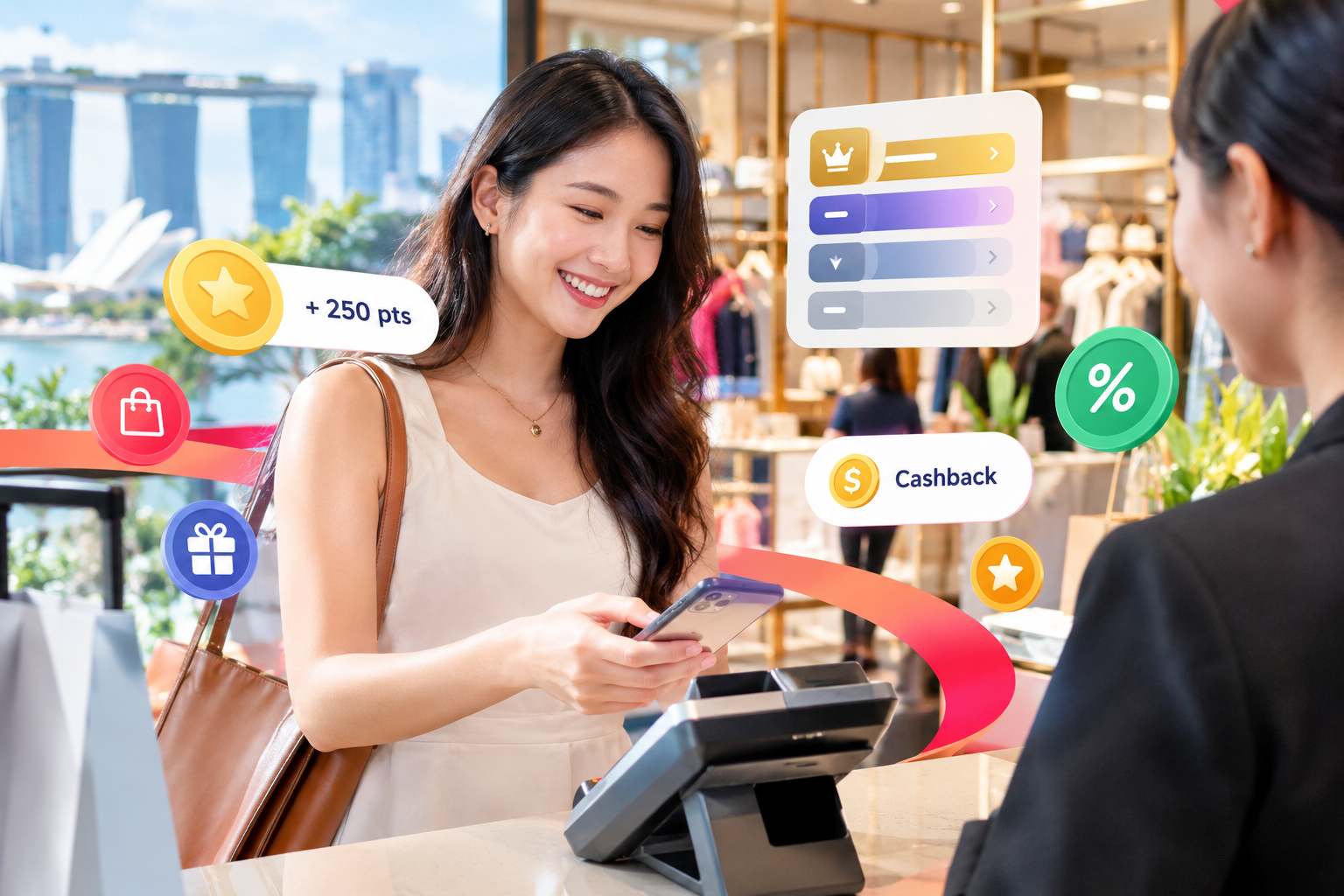
A customer loyalty program gives customers a clear reason to come back: a reward that grows with every visit. For cafes, restaurants, salons and retail stores in Singapore, it turns everyday purchases into repeat business.
This guide covers how loyalty programs work, the main types (points, stamps and tiers), how to choose one that suits your business, how to message members in line with Singapore’s rules, and how to measure results.
Key Takeaways:
- A customer loyalty program rewards repeat purchases with points, stamps or tiers, giving customers a clear reason to come back.
- Points suit varied spend, stamps suit frequent and similar purchases, and tiers suit regulars with higher-value visits.
- The right format starts from how customers already visit, and six simple steps take a program from idea to launch.
- Singapore’s PDPA and Do Not Call provisions apply to marketing messages, and clear and unambiguous consent lets those messages reach registered numbers.
- Five measures show how a program is doing: active members, repeat purchase rate, redemption rate, average spend per visit and reward cost against sales.
- Labamu Loyalty offers points per transaction that members can redeem, automatic vouchers and a dashboard.
Table of Contents:
- What Is a Customer Loyalty Program and How Does It Work?
- Why Loyalty Programs Matter for Singapore Businesses
- Types of Loyalty Programs: Points, Stamps and Tiers
- Digital vs Physical Loyalty Cards in Singapore
- How to Choose and Launch the Right Program for Your Business
- Staying Compliant with PDPA and Do Not Call Rules When Messaging Members
- How to Measure Loyalty Program Results
What Is a Customer Loyalty Program and How Does It Work?
A customer loyalty program is a structured way to recognise and reward people who buy from a business repeatedly. Members earn points, stamps or status with each purchase and exchange them for rewards.
Most loyalty programs for businesses follow the same loop:
Customer loyalty program
How the loyalty loop works
- 1JoinThe customer signs up, often with a phone number.
- 2EarnEach purchase adds points, stamps or progress toward a tier.
- 3RedeemThe customer exchanges what they have earned for a reward, such as a free item or a discount.
- 4ReturnThe reward gives a reason to visit again.
The loop also builds a useful record of who buys, how often and what they choose. That record helps a business plan offers that suit its regulars.
Why Loyalty Programs Matter for Singapore Businesses
Loyalty programs have become part of everyday life in Singapore, from supermarkets and banks to shopping platforms and delivery apps. ResearchAndMarkets projected Singapore’s loyalty market to reach US$501.5 million in 2025 (Business Wire, 2025).
The same report describes a shift toward mobile-first programs and toward flexible rewards such as non-expiring points and cashback (Business Wire, 2025). For local businesses, this is a helpful guide to what members expect: an easy way to join and rewards that are simple to use.
The report also expects the market to keep growing, by 14.4% annually, and notes that the retail and financial sectors are highly competitive, with consumers expecting greater value for their loyalty (Business Wire, 2025).
A well-run program can support a business in several ways:
- Repeat visits: a reward in progress gives customers a reason to return.
- Customer insight: purchase history shows which items and visit patterns matter most.
- Relevant offers: with consent, members can receive offers based on what they actually buy.
- Stronger relationships: recognising regulars builds familiarity that goes beyond price.
Types of Loyalty Programs: Points, Stamps and Tiers
Three formats cover most programs. Each suits a different visiting pattern, so it helps to know how they differ.
| Format | How it works | Best for | Watch out for |
|---|---|---|---|
| Points | Members earn points based on spend and redeem them for rewards | Retail stores and restaurants with varied purchase sizes | Needs a simple conversion so members understand a point’s value |
| Stamps | Members collect one stamp per qualifying purchase; a full card earns a reward | Cafes, bakeries and other places with frequent, similar purchases | Gives less extra credit to larger purchases |
| Tiers | Members move up levels as they spend or visit more, unlocking better benefits | Salons and restaurants with a regular clientele | Needs enough regulars, and adds more rules to explain |
Points programs
For example, a boutique could award points for every dollar spent and let members redeem them as a discount on a later purchase. Show the points balance at checkout so members always know how close the next reward is.
Stamp programs
For example, a cafe could offer a free drink once a stamp card is complete. Choose a number of stamps that a regular customer can realistically complete, so the reward feels within reach.
Tier programs
For example, a salon could offer priority booking to members at its top level. Favour benefits that recognise members without a discount, so higher tiers do not eat into margins.
Digital vs Physical Loyalty Cards in Singapore
A loyalty card is the way a member’s progress is recorded, and it can work with any of the formats above. Physical cards, such as paper stamp cards, are quick to start and familiar to customers. Digital cards keep progress on a phone or in a system linked to the member’s contact details, so rewards stay safe if a card is misplaced.
When comparing loyalty card options in Singapore, the Business Wire summary of the market highlights a move toward mobile-first programs, supported by high smartphone use (Business Wire, 2025). A digital loyalty card also makes it easier for members to check their progress at any time.
How to Choose and Launch the Right Program for Your Business
Start with how customers already behave, then pick the format that fits.
Match the format to visit frequency
- Frequent, similar purchases (a daily coffee, a lunch regular): stamps keep things simple.
- Varied spend (retail baskets, restaurant bills): points reward larger purchases fairly.
- Regular clientele with higher-value visits (salons, restaurants): tiers add recognition on top of rewards.
Match the format to your team
Pick the format your team can explain in one sentence at checkout and run consistently. A simple program that every team member can explain gives customers a clear reason to join.
Launch your program step by step
- Set one clear goal, such as more repeat visits or a higher average spend.
- Choose a reward that is easy to understand and worth earning.
- Keep sign-up quick, for example with a phone number at checkout.
- Ask for marketing consent clearly at sign-up (see the next section).
- Brief the team so every customer is invited to join at the counter.
- Review results after a set period and adjust rewards where needed.
Want to run these steps without tracking points by hand? Labamu Loyalty records points per transaction and issues vouchers automatically.
Common loyalty program mistakes to avoid
- Making the program too complicated. If the team cannot explain it in one sentence, customers will not join.
- Setting rewards that feel out of reach. A reward members never reach does not give them a reason to return.
- Skipping consent at sign-up. Marketing messages need clear consent, so ask early and record the answer.
- Not briefing the team. The program works best when every customer is invited to join at the counter.
- Tracking too many measures at once. Start with a few that match your goal, and change one thing at a time.
Staying Compliant with PDPA and Do Not Call Rules When Messaging Members
A loyalty program makes it easy to message members, so it helps to know the rules that apply in Singapore. The Do Not Call (DNC) provisions of the Personal Data Protection Act (PDPA) cover marketing voice calls, text messages and fax messages sent to Singapore telephone numbers listed in the DNC Registry (PDPC).
According to PDPC, organisations can follow these practices:
- Send with consent: marketing messages can go to a number when the recipient has given clear and unambiguous consent, and a registry check is then unnecessary. The consent should be recorded in written or another form that can be accessed later as evidence, so keep a record of each member’s choice.
- Offer an easy opt-out: explain how to opt out using the same medium as the message, and stop sending within the timeframe PDPC sets after an opt-out.
- Identify the business: include the organisation’s name and contact details in text messages.
- Understand ongoing relationships: PDPC allows certain messages to customers with an ongoing relationship, and treats an ongoing relationship as more than a series of one-off transactions.
A simple way to apply this is to ask for consent at sign-up, through a clear tick box or a short question at the counter, and to note each member’s choice in your system.
This section is general information and not legal advice. For other channels and the latest details, see the PDPC guidance.
How to Measure Loyalty Program Results
Choose a few measures that match the goal you set at launch, and review them on a regular schedule. These five cover most programs:
| Measure | What it shows | How to calculate |
|---|---|---|
| Active members | Whether sign-ups turn into regular use | Members who earned or redeemed in the period ÷ total members |
| Repeat purchase rate | Whether customers come back | Customers who bought more than once in the period ÷ all customers in the period |
| Redemption rate | Whether rewards feel attractive and within reach | Rewards redeemed ÷ rewards earned |
| Average spend per visit | Whether members spend differently from other customers | Total sales ÷ number of visits, compared for members and non-members |
| Reward cost against sales | Whether the program stays worthwhile | Cost of rewards given ÷ sales from members, in the same period |
For example (illustrative figures): if members spent S$10,000 in a month and the rewards given cost S$400, reward cost against sales is 4%.
Look at trends over several periods rather than a single week, and compare members with non-members where possible. When a measure moves, adjust one thing at a time, such as the reward or the number of purchases needed, so the effect is easy to read.
What Is Labamu Loyalty and How Does It Work?
Labamu is an Indonesia-based platform of integrated business solutions that helps businesses manage their day-to-day operations, and it has expanded into Singapore. Labamu Loyalty is its loyalty feature: it lets a business run a points program that is recorded as sales happen, so owners do not have to track rewards by hand.
Running a program by hand works at the start. Once a business has regular members, tracking points and rewards takes more time, and a system keeps the routine simple.
Here is how the loop can run day to day with Labamu Loyalty, using a cafe as an example:
- Earn: each transaction earns the member points, so progress is recorded as sales happen.
- Redeem: members can redeem the points they have earned.
- Reward: vouchers are issued automatically, so the team has fewer manual steps.
- Review: a dashboard gives the owner one place to follow how the program is going.
Illustrative dashboard layout
Five measures worth tracking
Illustrative layout, not a screenshot of Labamu Loyalty.
Labamu publishes this guide and offers Labamu Loyalty, so the example above reflects its own product.
Frequently Asked Questions
What is the difference between a loyalty program and a loyalty card?
A loyalty program is the full system of rules, rewards and member records that encourages repeat purchases. A loyalty card is one way to track a member’s progress, either on paper or digitally. Any program format, whether points, stamps or tiers, can run on a loyalty card.
Which type of loyalty program suits a cafe?
Stamp programs suit cafes with frequent, similar purchases because they are easy to explain at the counter. Points programs suit cafes with a wide range of order sizes, since larger orders earn more. Choose the format your team can explain in one sentence at checkout.
Can a salon or other service business run a loyalty program?
Yes. Points or tiers based on spend or visits suit appointment-based businesses, since every visit is still a purchase that can earn rewards. A salon, for example, can offer points per booking or priority booking for its top tier of regular clients.
Can I message members who are listed on the Do Not Call Registry?
PDPC states that a registry check is unnecessary when the recipient has given clear and unambiguous consent, in a form that can be evidenced, to receive marketing messages on that number. Without that consent, check the registry first. This is general information, so confirm the details with PDPC.
Which measures should a new loyalty program track first?
Start with active members and repeat purchase rate, which show whether sign-ups turn into regular visits. Add redemption rate and average spend per visit once the program has some history, then reward cost against sales to confirm the program stays worthwhile.
How do I start a loyalty program for a small business?
Set one clear goal, choose one format that fits how customers already visit, keep sign-up quick, and ask for marketing consent at sign-up. Brief your team so every customer is invited to join, then review results after a set period and adjust the rewards.
Are digital loyalty cards better than paper cards?
Digital cards keep progress on a phone or in a system linked to the member’s contact details, so rewards are safe if a card is lost, and members can check progress anytime. Paper cards are quicker to start. The better choice depends on your team and customers.
Conclusion
A customer loyalty program works well when its format matches how customers already visit: stamps for frequent, similar purchases, points for varied spend, and tiers for regulars with higher-value visits.
Start simple. Choose one format, set one goal, ask for consent clearly at sign-up, and review a few measures on a regular schedule. Adjust one thing at a time as the program grows.
If you want to see how this works in more detail, you can explore Labamu Loyalty.
Sources
- Business Wire (2025), Singapore Loyalty Programs Intelligence Report 2025, ResearchAndMarkets.com
- Personal Data Protection Commission (PDPC), Advisory Guidelines on the Do Not Call Provisions